
You are running on twenty watts
Your brain runs a whole mind on less power than a fridge bulb. Physics permits computing ten thousand to a million times better than we manage. The expensive part was never the thinking, it was the commute.

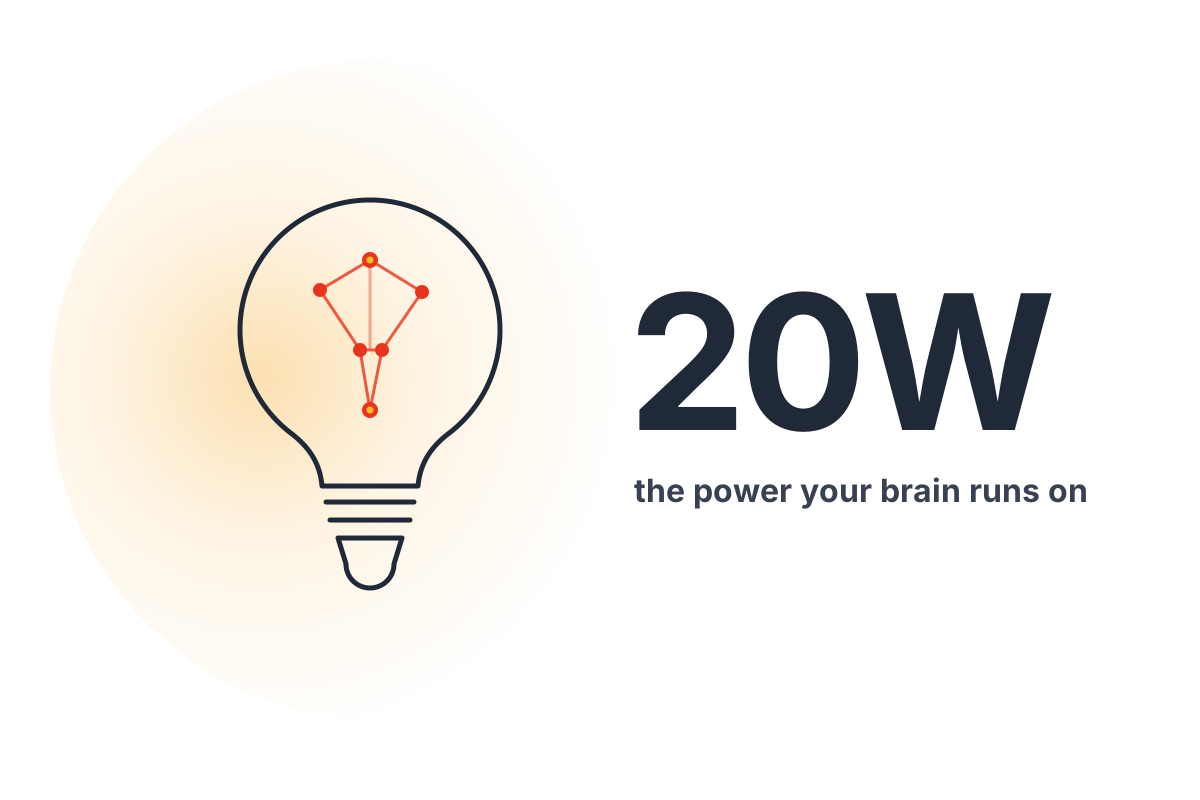
Less than the bulb in your fridge. And with it you are doing something no machine on earth can yet match at any price.
Right now, reading this sentence, you are running vision, language, memory, planning and movement, continuously, in parallel, on roughly the power of a dim lightbulb. You have been doing it since before you could speak. You will keep doing it while you sleep.
Meanwhile, teaching one large AI model to write passable English consumed enough electricity to run a hundred and twenty homes for a year.
| 20 W | 1,287 MWh |
|---|---|
| a human brain, continuously | training one model, once |
It would be comforting to conclude that biology is simply magic, and leave it there. But there is a more useful question, and a physicist asked the template for it in 1959.
Feynman’s question
Richard Feynman stood up in front of the American Physical Society and asked why nobody had written the Encyclopaedia Britannica on the head of a pin. He was serious. He did the arithmetic on stage and showed that the laws of physics did not forbid it, that in fact there was an enormous amount of unused room down there at the small scale. Then he offered a thousand dollars to whoever went and did it.
Somebody eventually did. But the prize was never the point. The method was:
Stop measuring yourself against last year. Measure yourself against what physics actually allows.
If the answer is “not much further”, you are near the end of the road and your effort belongs somewhere else. If the answer is “an enormous distance”, then whatever is holding you back is not a law of nature. It is a design choice, and design choices can be changed.
So we asked what thinking costs, and whether there’s room at the bottom of energy here too.
There is a great deal of room
The physics of computation has a floor. It was worked out in 1961 and measured in a laboratory fifty years later, and it says that computing only has to cost energy when it throws information away. Everything else is, in principle, free.
Charge today’s AI at that floor, correct honestly for every reason the real world is messier than the theory, and the distance still left is somewhere between ten thousand and a million times.
10,000×
to a million times better, still permitted by physics
To put that in perspective: the entire history of computing, from room-sized machines that needed their own power substations to the phone in your pocket, is about eleven orders of magnitude of efficiency improvement. Roughly half of that journey is still ahead of us, unclaimed, sitting there, allowed.
We are not bad at thinking. We are bad at fetching.
Here is the part that surprised us most, and it is the reason to be optimistic rather than despairing.
When you look inside an AI chip and ask where the electricity actually goes, only about half of it is spent on the arithmetic itself. The rest goes on memory: storing the numbers and fetching them back to where the arithmetic happens. And moving a number turns out to be far more expensive than using it.
6,400×
what fetching a number costs, versus adding it
Imagine a kitchen where chopping an onion takes one second, but every ingredient has to be carried back from a warehouse a mile down the road. Nobody would call that a chopping problem. You would move the warehouse, and you would stop describing the chef as slow.
The expensive thing was never the thinking. It was the commute.
Your brain does not have this problem. A brain does not fetch a memory from storage and carry it to a processor. The connection is the memory. The computing happens exactly where the information already lives, which is why it can run an entire mind on twenty watts.
What becomes possible
Efficiency sounds like a small, worthy, boring virtue. It is not. Every time computing has become dramatically cheaper, the change has not been that we did the same things for less money. It is that entirely new things became possible, and then became ordinary.
Cheap enough computing turned a machine that filled a room into something a teenager could own, and then into something everyone carries. If intelligence gets a thousand times cheaper to run, it stops being a service you connect to and starts being a property that things simply have.
- A hearing aid that understands conversation. Not a microphone that amplifies noise, but a device that knows which voice you are trying to listen to, running all day on a battery the size of a coin.
- Medicine that thinks where the patient is. Diagnosis on the device, in the room, in the field, with no connection required and no recording of anyone’s body leaving the building.
- Instruments in places with no infrastructure. Soil sensors, water monitors and diagnostic tools that reason locally, on a solar cell, in places that will never have a data centre nearby.
- Intelligence that is not metered. When thinking costs almost nothing, it stops being rationed by who can afford the bill. That is a change in who gets to use it, not just in what it costs.
None of that is unlocked by a better chatbot. All of it is unlocked by making intelligence small enough and cheap enough to sit where the problem is.
What we have actually found
This is the part where a talk like this usually promises the breakthrough. We would rather tell you what our own measurements say, including the parts that went against us.
We have been building machines that compute the way physical systems settle, rather than the way processors fetch. Coupled oscillators, working at the edge of chaos, like metronomes on a shared table falling into step. It is a beautiful idea.
Most of what we measured argued against the romantic version of it. The part exotic hardware would have accelerated turned out to be under one percent of the work. Built the way real physical hardware would have to be built, quality got substantially worse. The efficiency win we could actually demonstrate turned out to be an ordinary digital one.
We will publish that as we progress, because a gap this large will not be closed by people who only report the results that flatter them.
But one thing did surprise us, and it is the reason we are still going. Training a large model (131M and 1B text models), we found most of its layers had fallen into perfect agreement with themselves, and a system in perfect agreement is carrying no information at all. It looked healthy by every measure we were watching. It had quietly stopped thinking. The perfect order does no good.
That failure has a name in nonlinear systems. Interesting behaviour lives in a narrow band between rigid order and total chaos, and we had fallen off the ordered side without noticing. Finding the edge of that band, deliberately rather than by accident, is a real research question, and it is ours.
The room is real
We do not know which road gets there. It might be shorter wires and cleverer memory. It might be machines organised on a principle nobody has committed to yet. Betting against conventional silicon has historically been a good way to lose money, and anyone who tells you the answer is obvious is selling something.
What we do know is the shape of the problem. The gap between what we spend and what physics permits is not a rounding error, it is most of the remaining road. Most of that gap is not thinking, it is transport. And a working example of the destination is sitting inside your skull, running on twenty watts, doing something no data centre can do at any wattage.
Feynman was right that there was plenty of room at the bottom. There is plenty of room in the energy budget too.
Somebody is going to go and take it.
We build compression research and on-device intelligence, and we publish the measurements that go against us alongside the ones that do not. The same argument with the numbers shown · The full technical essay, with sources and objections