
Most of the energy AI uses isn't spent thinking
Training one large model can burn 1,287 megawatt-hours. Physics says the same arithmetic could have cost about eight watt-hours. Where the difference goes, what we tried, and what failed.

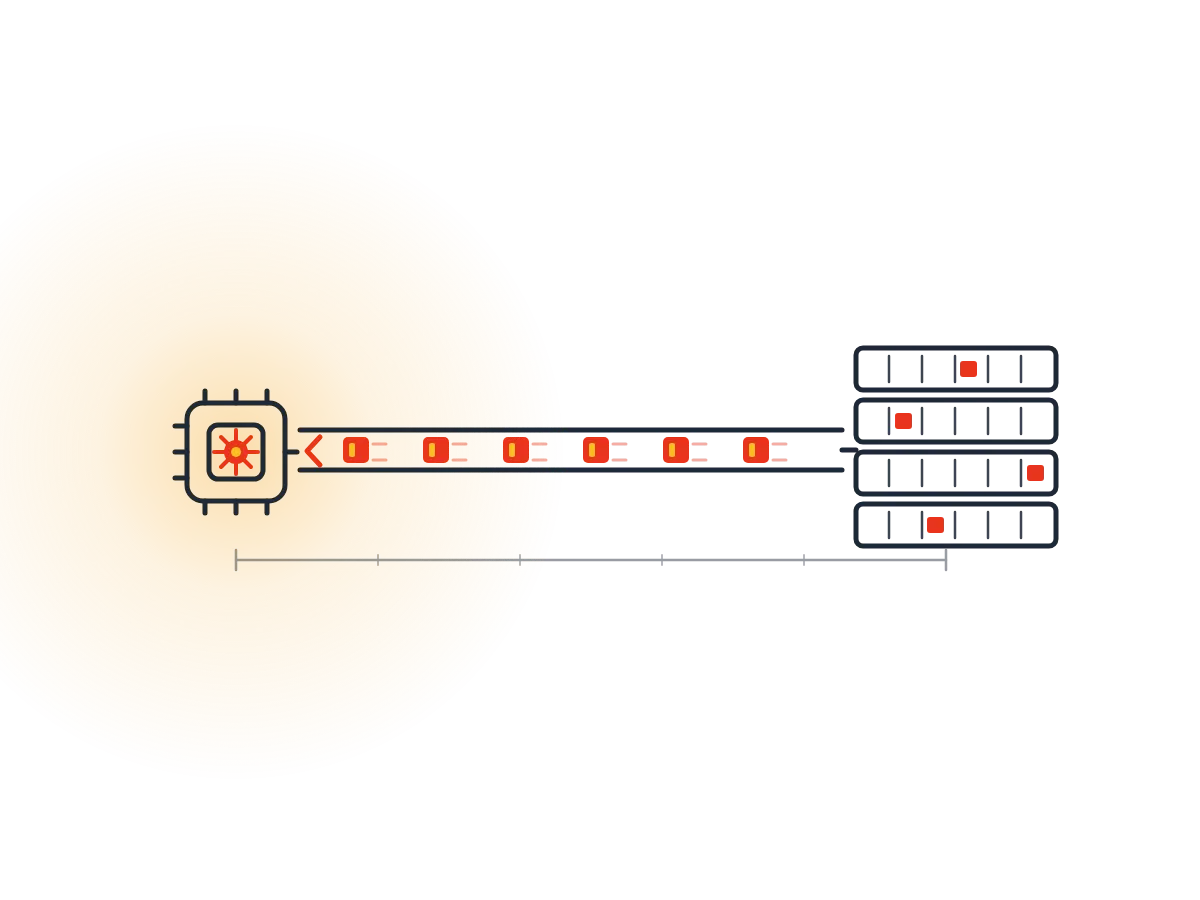
In 1959 the physicist Richard Feynman asked an apparently silly question: why can’t we write the entire Encyclopaedia Britannica on the head of a pin? He wasn’t joking. He did the arithmetic on stage, showed that shrinking the text that far would still leave each dot of ink about thirty-two atoms across, and concluded that nothing in physics forbids it. He offered a thousand dollars to whoever managed it. A graduate student collected the cheque twenty-six years later.
The useful thing about Feynman’s question wasn’t the pin. It was the method: measure the distance between what we currently do and what the laws of physics actually permit. If the gap is small, stop: you’re near the end of the road. If it’s enormous, then whatever is stopping you isn’t physics, and it’s worth finding out what it is.
Run that same calculation for the energy cost of artificial intelligence, and the gap comes out bigger than the one Feynman pointed at, the one that launched nanotechnology.
The floor is a very long way down
In 1961 an IBM physicist named Rolf Landauer worked out the thermodynamic price of computing. His answer was precise and surprising: computing is only obliged to cost energy when it destroys information: when it overwrites something and the previous value is gone forever. Everything else can, in principle, be done for free. In 2012 the bound was measured directly in a laboratory, using a single microscopic bead in a light trap.
Charge a training run at that theoretical rate and the electricity bill comes to something like a phone charge. The actual bill is a hundred million times larger.
A little bit of reality
Landauer’s floor describes a perfect operation performed infinitely slowly with no margin for error. Real switches have to be fast and reliable, and reliability costs energy, and that alone eats a few hundred-fold. The comparison also pits a whole data centre, cooling included, against an idealised single operation.
Correct for all of it and the honest remaining headroom is somewhere between ten thousand and a million times. Still enormous: roughly half the entire efficiency gain of computing history, from ENIAC to now, still sitting unclaimed.
The problem is the commute, not the compute
So where does it all go? Not, mostly, into calculating. It goes into fetching.
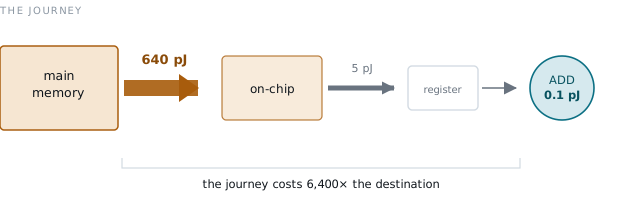
Arrow thickness is proportional to energy on a log scale. Figures from Mark Horowitz’s 2014 survey, measured at 45 nanometres. Newer chips shift the absolute numbers down; the ratio has proved stubborn, because wires have not shrunk the way transistors have.
Imagine a kitchen where chopping an onion takes a second, but every single ingredient has to be walked back from a warehouse a mile away. You would not describe that kitchen as a chopping problem. You would move the warehouse.
This is exactly what the last decade of AI hardware has been about: bigger caches, memory stacked directly onto the processor, chips the size of dinner plates, numbers squeezed into fewer digits so more fit per trip. Every one of these is a real improvement. Every one is also a workaround for the same arrangement: the memory is over here, the computing is over there, and the numbers have to commute.
The calculating was never the expensive part. The travelling is.
Waiting for better chips stopped working
For thirty years you could simply wait. Transistors shrank, and shrinking made them both faster and cooler at the same time, a free lunch with a name: Dennard scaling. It ended around 2005, which is why the clock speed of your laptop has barely moved since, and why chips grew more cores instead.
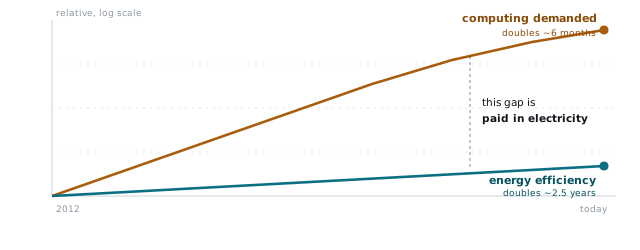
Drawn from published growth rates, not a fitted dataset. The absolute positions are illustrative; the divergence is the point. Increasingly it shows up as grid connections and cooling limits rather than anything on a spec sheet.
There is a working example in your head
Feynman had no machine that could write at atomic scale, only the argument from physics. On energy we are luckier. There is a system reading this sentence right now that handles vision, language, memory, planning and movement continuously on about twenty watts. Less than the bulb in your fridge.
The brain is not magic, and the interesting part is that it is clearly working under a budget. Careful accounting suggests only around one percent of neurons can be active at any moment. It cannot afford to think with all of itself at once. Three things follow, and they read like a list of everything a modern AI chip does differently: almost nothing is switched on at any given time; connections are mostly short and local, because long wires are expensive; and, most importantly here, the memory and the computing are the same object. A neuron does not fetch a value from storage. The connection is the value. There is no commute.
Where the comparison stops being useful
“The brain does it this way” is a reason to investigate an idea, not evidence that it will work. Brains and data centres are under different constraints, and one of these three principles, switching almost nothing on, has already been adopted by conventional AI on purely engineering grounds, with no biological argument needed.
What we tried, and what didn’t work
We asks whether a machine built on different physics could close some of that gap: instead of shuttling numbers to a processor, use a system of coupled oscillators (think metronomes on a shared table, which spontaneously fall into step) and let the answer emerge from the settling to reach the edge of chaos rather than from fetched instructions.
It is a genuinely appealing idea, and most of what we have measured so far argues against the romantic version of it. We built a 131M and 1B parameter equivaelent of LLM, an image generator inspired by Un-0 model and few others. We got some early positive and some very negative results.
We think that is worth discussing, blogging and publishing rather than burying.
| What we tried | What happened | Verdict |
|---|---|---|
| Let the physics do the computing | The settling step, the part real oscillator hardware would accelerate, turned out to be under 1% of the total work. Make it infinitely fast and you have changed almost nothing. | Didn’t hold |
| Build it the way physical hardware would | Real oscillator arrays have fixed wiring. Constrained that way, the model’s language quality got 63% worse. The physics you would be buying is not the physics the model was using. | Didn’t hold |
| Keep the idea, drop the exotic hardware | Computing the connections once and reusing them, an ordinary digital shortcut borrowed from the oscillator framing, matched full performance at lower cost. | Held up |
(arXiv pre-print to follow)
So the efficiency win we can actually demonstrate is a digital one. That is a duller answer than “computing with physics”, and it is the one the measurements support.
The one place the physics did surprise us
There is a strand of nonlinear-systems research, associated with Leon Chua, holding that interesting computation lives in a narrow band between rigid order and complete chaos. Too ordered and a system just repeats itself. Too chaotic and it never settles on anything. The useful behaviour sits at the boundary, the edge of chaos.
We did not set out to test that. We ran into it. Training a billion-parameter oscillator model, we found ten of its sixteen layers had fallen into near-perfect synchronisation, with every oscillator agreeing with every other. A layer in that state is not computing. It has erased the very distinctions it was supposed to be carrying. The alarming part is that none of the usual training metrics showed it. The loss curve looked healthy. Only measuring the synchronisation directly revealed that most of the model was dead.
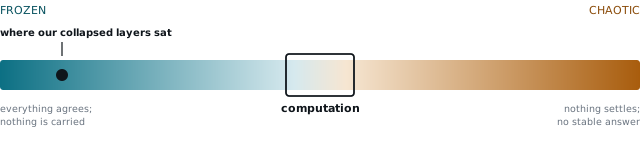
A failure mode that looks like success. Ten of sixteen layers had synchronised almost perfectly. Confident, stable, and carrying no information, and invisible to every metric we were watching except the one that measures agreement directly.
That is a small result, and a useful one. It says the interesting regime is real and narrow, that you have to instrument for it deliberately, and that a system can look healthy while most of it has quietly stopped working. It is also the strongest argument we have found for continuing to take the nonlinear route seriously, having just spent three paragraphs arguing against the easy version of it.
What we build with all this
If the expensive thing is moving data, the most direct response available today is not just the exotic hardware. It is to make the model small enough that it can sit where the work happens, and to stop the largest data movement of all, the round trip to a data centre.
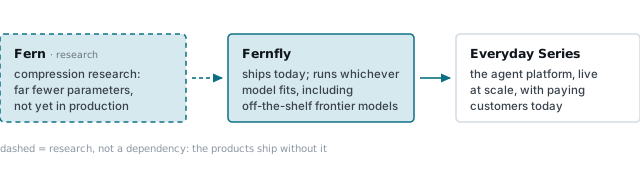
The research is a bet on direction, not a dependency. Fern is where we test whether much smaller models hold their quality. Fernfly and Everyday Series ship today and run whichever model suits the job, frontier models included.
That work is applied to open-weights models (Qwen, Llama, BGE and others) across language, vision, genomics, protein and diffusion. A smaller model is not just cheaper to store. It is a model whose numbers travel a shorter distance every time it is asked a question, which is the only lever in this whole essay available on hardware that already exists.
One caveat, since it would be easy to read more into this than is there. Our own compressed models are still in research, and they are not what powers the products today. Fernfly and Everyday Series ship now, and run off-the-shelf frontier models perfectly well. The research is a bet on where this goes, not something the products are waiting on.
What we think is true
The room at the bottom is real. Physics permits something like four to six orders of magnitude better than what we do today, and that is not a rounding error; it is most of the remaining road. The memory wall is real too, and it is not a secret: the clearest statements of it come from the companies with the most invested in the current arrangement.
What is not settled is which road gets there. It might be shorter wires: optical links, stacked chips, memory pushed ever closer to the processor. It might be a machine organised on a different principle, in which case somebody has to show it beating not today’s hardware but the hardware of the year it actually ships. Betting against conventional silicon has a poor historical record.
What we can say is that the gap is worth taking seriously, that most of it is a transport problem rather than a thinking problem.
Read next · technical version: There’s Plenty of Room at the Bottom of the Energy Budget
The same argument with the arithmetic shown: Landauer’s bound and the dispute over whether it has ever been properly proved, the reliability floor that raises it, reversible computing and what it charges instead, the full energy ladder across twelve decades, and the sources for every figure quoted here.
Sources
- AI training energy: ~1,287 MWh for one large model. Patterson et al., Carbon Emissions and Large Neural Network Training (2021). arxiv.org/abs/2104.10350
- Per-operation energy: fetching a number (~640 pJ) vs adding it (~0.1 pJ), ≈6,400×. Mark Horowitz, Computing’s Energy Problem (and what we can do about it), ISSCC 2014. gwern.net/doc/cs/hardware/2014-horowitz-2.pdf
- The physics floor. Rolf Landauer, Irreversibility and Heat Generation in the Computing Process, IBM J. Res. Dev. (1961). Landauer 1961 (PDF)
- The floor, measured. Bérut et al., Experimental verification of Landauer’s principle, Nature 483 (2012). nature.com/articles/nature10872
- “There’s Plenty of Room at the Bottom.” Richard Feynman, APS (1959); the prize was collected by Tom Newman in 1985.
- Compute demand doubling ~every six months. Sevilla et al., Compute Trends Across Three Eras of Machine Learning (2022). arxiv.org/abs/2202.05924
- The brain’s budget: ~20 W, ~1% of neurons active at once. Attwell & Laughlin (2001); Peter Lennie, The Cost of Cortical Computation, Current Biology (2003). Lennie 2003 (PDF)
Oscillator results are our own, measured at 131M and 1B parameters.